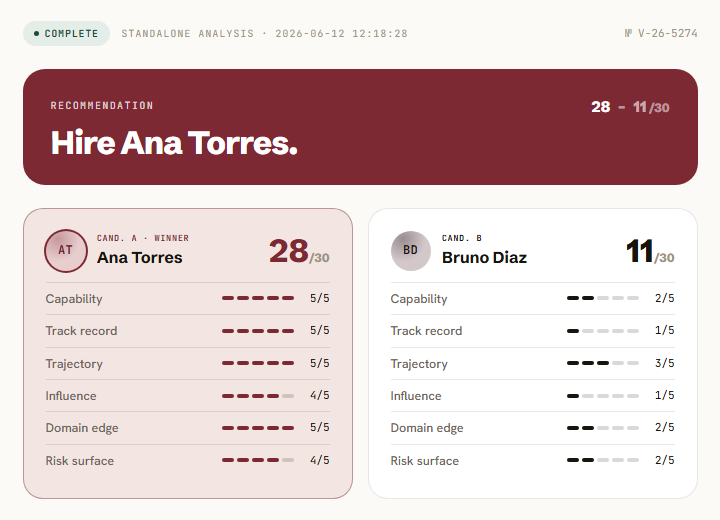
The full product is above. Here's how it works inside.
The score is a rubric, not a vibe.
Six dimensions — Capability, Track record, Trajectory, Influence, Domain edge, Risk surface — each scored 1–5, out of 30. Scoring disregards identity by instruction — names, gender, and age are set aside, and in a head-to-head the candidate order is randomized before a blind synthesis assigns the scores.
Every claim points at the CV.
Around ten quotes per analysis, lifted word for word: [EVIDENCE: "scaled ARR from $3M to $14M"]. No quote, no claim.
It warns you, in writing.
Over-qualification and retention-risk flags sit on the document itself, beside five interview questions and three reference-check questions per candidate. The verdict tells you what to probe, not just whom to prefer.
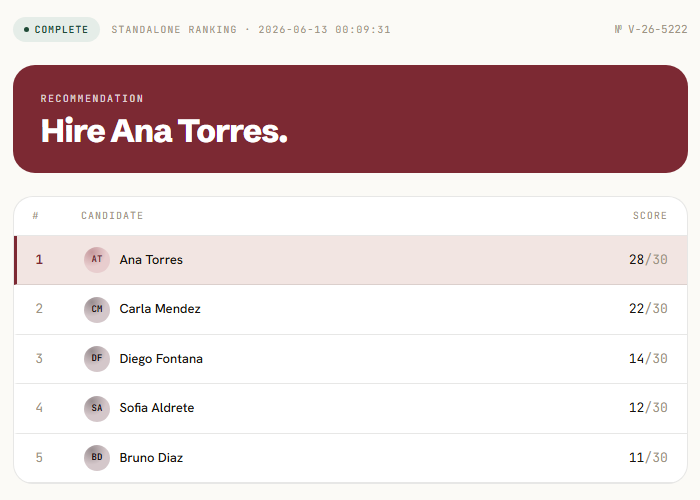
How Verdict ranks 2–50 CVs against a job description.
Where Verdict breaks.
Verdict reads what is written. It cannot see how someone thinks on their feet — that is the interview's job. So every verdict ships a printable interview kit per candidate, its questions aimed at exactly what the CV could not prove. Interviews Thursday? You'd walk in with one for each finalist.
A verdict that holds up after the interview.
Calibrated to your bar.
Upload 5–50 past hires with outcomes — still here, promoted, let go — and Verdict compiles an org profile applied as context in future analyses ("your hires weight Capability and Track record most heavily"). A 90-day follow-up keeps it current.
Revised on evidence, not on mood.
Paste the interview transcript or your notes; Verdict re-examines the case and issues a revision delta — "Recommendation unchanged — 24 → 26/30" (sample) — each change citing the transcript verbatim. Revisions carry SHA-256 fingerprints, current and superseded.
Filed for the record.
Record your decision — Hired, Rejected, Pending — with rationale, and export an audit-grade defensibility report, fingerprinted. A decision unwritten is a decision unowned. (Promote mode does the same for internal candidates: ready now, 6 months, or 12–18, with a four-step development plan.)
Pricing, in plain figures.
1 credit = 1 candidate analyzed. Pay once. No subscription. Credits never expire.
Hiring is occasional; your tooling bill shouldn't pretend otherwise. Buy credits when a role opens; whatever remains waits, un-expired, for the next search. No seats, no renewal date, no invoice arriving in a month you didn't hire.
Frequently Asked Questions
Is AI CV screening biased?
Verdict is identity-blind by design: names, gender, and age are set aside, candidate order is randomized, and the synthesis that assigns scores never sees who it is scoring. That is a guardrail, not a guarantee — but it is a real one, and a conclusion that cannot cite the CV does not ship.
How fast is it?
Minutes from upload to verdict for a typical run. No onboarding, no demo call, no setup.
What does one credit include?
A multi-pass read of one CV against your JD, the six-dimension score, typically around ten verbatim citations, risk warnings, five interview questions, three reference-check questions, and the interview kit.
What if it just confirms what I already thought?
Then you've spent nothing — your first head-to-head is free. If it changes your mind once, it has earned its keep for every hire after.
Does it work for internal promotions?
Yes. Promote assesses a current employee's readiness for their next role from performance reviews and the role description: a readiness verdict (now, 6 months, 12–18 months or not aligned), three strengths, three gaps and a development plan. Same evidence discipline, a different kind of decision.